
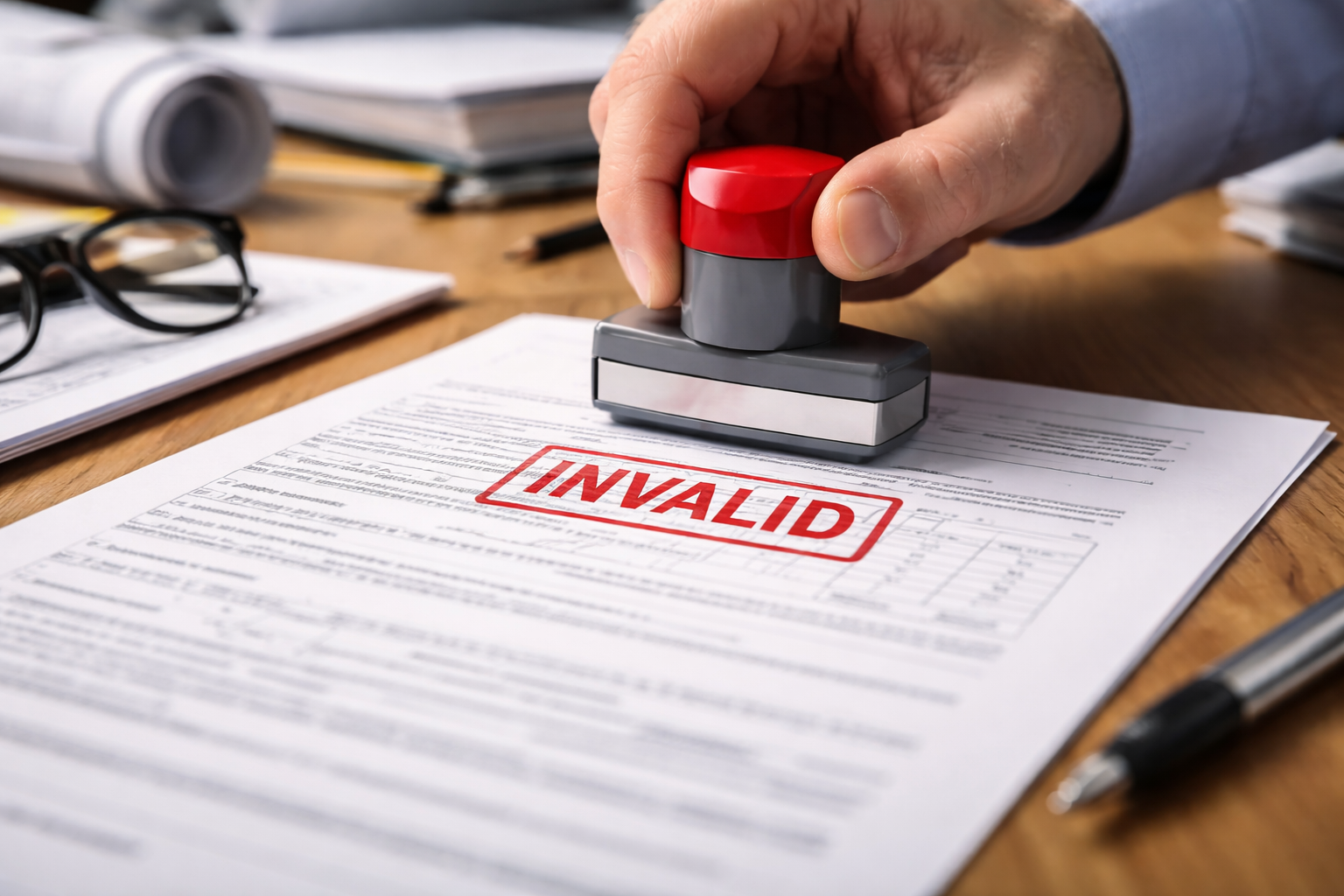
Planning application invalidations are one of the most common early problems in the planning process, yet they are often treated as if they are just minor procedural setbacks. In practice, they can have a much wider effect on project delivery. When a Local Planning Authority declares an application invalid, the proposal does not move into formal determination. Instead, it is returned so missing information, document errors or procedural issues can be corrected before it can be registered. That means delay before assessment has even begun, along with extra coordination, disrupted timescales and avoidable internal rework.
For practices preparing planning submissions, this matters because invalidation is rarely about the planning merits of a scheme. More often, it reflects whether the submission pack has been assembled clearly, consistently and in line with the authority’s published requirements. In other words, it is often a documentation and coordination problem rather than a design problem.
Every Local Planning Authority publishes a validation checklist setting out what must be included before an application can be accepted. Some of these requirements are broadly standard, but many are shaped by local policy, site context and authority-specific expectations. Heritage, flood risk, trees, ecology and design policy can all affect what needs to be submitted. As a result, an application that is valid in one authority may still be returned in another because the supporting material is not sufficient for that local context.
The same issues tend to appear repeatedly. Ownership certificates may be incomplete or incorrect. Location plans may be submitted at the wrong scale or without a properly defined red line boundary. A Design and Access Statement may be missing where one is required. Supporting reports may not have been included even though the site or proposal triggers them. In other cases, the problem is less about missing information and more about presentation: inconsistent drawing titles, mismatched revisions, vague descriptions of development or file names that make it harder for the authority to identify what has been submitted.
These are not usually failures of professional knowledge. Most teams involved in planning submissions understand what good practice looks like. The difficulty is that application packs are assembled across multiple moving parts: drawings, supporting reports, consultant inputs, ownership checks, notices, plans and local authority requirements. Without a structured process, fairly small inconsistencies can slip through and become validation failures.
This is where Architectural Technologists often play an especially important role. In many practices, they sit at the centre of submission preparation, coordinating drawings, technical information and consultant material while helping ensure that the final pack is coherent and complete. That role is more significant than it can appear at first glance, because the quality of that coordination often determines whether an application proceeds smoothly or is delayed at the first hurdle.
Many validation problems arise not because requirements are unknown, but because they are checked too late. By the time the full pack is being reviewed, deadlines may be tight, information may still be arriving from consultants, and important details are easier to miss. Ownership issues that should have been identified at the start of the project are discovered near submission. Supporting documents that should have been triggered by the site context are noticed only when someone compares the pack against the authority’s checklist. Plans that looked acceptable internally turn out not to meet the authority’s formatting or scale expectations. What should have been a controlled process becomes a last-minute scramble.
The practices that tend to reduce invalidation risk most effectively are usually not doing anything dramatic. They are simply building structure into the submission process earlier. That might mean turning LPA validation lists into internal working checklists that can be used during preparation rather than only at the end. It might mean confirming ownership and notice requirements at an early stage instead of treating them as a final administrative step. It might mean checking plan standards properly, including scale, boundary clarity, north point and surrounding context, before documents are uploaded. It also means keeping file naming and document control disciplined enough that the pack can be reviewed without confusion.
That last point sounds mundane, but it matters more than people sometimes admit. A well-ordered submission pack with clear document names and consistent revisions is easier to validate and easier to understand. A poorly controlled pack creates friction immediately. The authority has to spend longer working out what has been submitted, whether the right documents are present, and whether key information matches across the set. Once that friction appears, the chance of queries and delays increases.
The wider point is that invalidation is not just a problem for one application. It affects how a practice operates. It creates rework, interrupts programmes and weakens confidence in delivery. It also affects the client experience, because even where the design work is strong, the application can appear stalled for reasons that feel preventable. For a profession built around technical coordination and delivery standards, that should not be taken lightly.
This is also why more structured forms of submission infrastructure are beginning to emerge. As planning becomes increasingly digital, there is a growing need for systems that help professionals align submissions with published Local Planning Authority requirements before an application is formally made. That is the thinking behind UK Planning Gateway. It has been developed as a validation intelligence layer designed to support planning submissions across England and Wales by helping professionals prepare application packs against documented authority requirements in a more consistent way.
The aim is not to replace professional judgement, because no system can remove the need for experience, interpretation and technical coordination. The aim is to support that judgement with better structure. Where requirements are clearer, checks happen earlier and submission packs are assembled more consistently, the risk of avoidable invalidation falls.
Architectural Technologists are well placed to lead that shift. Their role already sits between design information, technical coordination and delivery. As planning submissions become more complex and documentation expectations continue to grow, the ability to produce clear, complete and well-structured application packs becomes even more important. Reducing invalidations is not just about avoiding delay. It is part of maintaining standards, protecting project momentum and improving the reliability of the planning process for everyone involved.
UK Planning Gateway is built around that principle. Better validation starts before submission, not after rejection.